

Risa
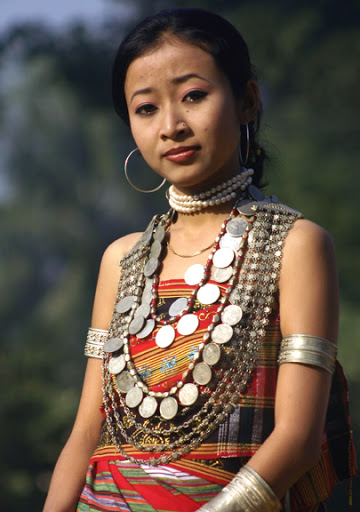
- Risa is one of the three parts of a customary Tripuri female attire, the other two being the Rignai and Rikutu
- The Risa, which is essentially a customary handwoven cloth, is used as a head gear, stole, female upper cloth or presented to honour a distinguished recipient
- The Rignai is primarily used to cover lower part of the body and literally translates into ‘to wear’
- The Rituku covers the upper half of the body, wrapping it all around
- However, it is also used like a ‘chunri’ or a ‘pallu’ of the Indian saree. It is also used to cover the head of newly married Tripuri women
Best “PSIR Answer Writing” course visit www.upschacks.com
- The Risa plays a host of crucial social utilities. Adolescent Tripuri girls are first given risa to wear when she reaches 12-14 years in an event called Risa Sormani.
- The event involves prayers to a Lampra god, where her elder women pray for her wellbeing throughout her life. Risa is primarily used as a breastcloth and is wove in different colourful designs
- However, it is also used in religious festivals like the Garia Puja, a customary festival of the tribal communities, or as a head turban by male folks during weddings and festivals, as a cummerbund over dhoti, head scarf by young girls and boys, muffler during winters
- The cloth is even used as a makeshift baby carrier on the mother’s back
- The government is trying to weave the Risa into its policy for self-employment
- As of 2018, Tripura had 1,37,177 handloom weavers, according to the National Handloom Census, with 60 handloom clusters
- However, only a handful of them exclusively work on traditional tribal handloom.

You may also like


BRO to build First Steel Slag Road in Arunachal Pradesh
20 August, 2022
“Dahi-Handi” Recognised as an Official Sport of Maharashtra
20 August, 2022